
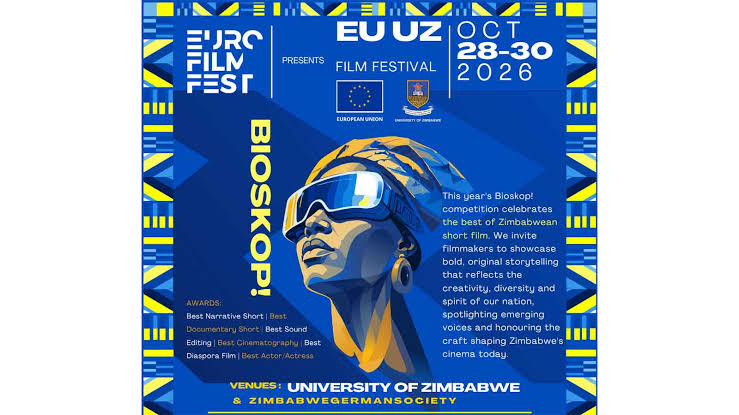
The European Film Festival Zimbabwe returns to Harare from Wednesday, October 28, to Friday, October 30, featuring European and Zimbabwean filmmakers for three days of cinema, cultural exchange, professional development and conversations about the future of the local film industry.
Hosted by the European Union in partnership with EU Member States, the 2026 edition is running under the theme The Next Frame, placing the spotlight on new storytelling opportunities, international collaboration and the development of Zimbabwean filmmaking talent.
The festival features films from Romania, Ireland, Spain, Madagascar and Belgium, alongside a selection of Zimbabwean short films, creating a platform for audiences to experience different cultures, perspectives and approaches to filmmaking.
Beyond film screenings, the programme brings together actors, directors, students, producers and other creative industry professionals through exhibitions, masterclasses, workshops and panel discussions designed to strengthen professional connections and encourage knowledge-sharing.
Speaking ahead of the festival, European Union Delegation to Zimbabwe Chargée d’Affaires a.i. Francesca Fabbri said the event was beyond bringing European productions to the local audience, highlighting the importance of giving Zimbabwean filmmakers opportunities to showcase their work.
She said the festival sent a message to young filmmakers that their stories mattered and that their voices deserve to be part of wider conversations about cinema.
Festival director Rumbi Katedza said, “the theme, The Next Frame, reflects a forward-looking approach to Zimbabwean cinema and the creative relationships that could help shape its future.”
She expressed hope that the festival would encourage meaningful exchanges between Zimbabwean and European creatives, open doors for emerging filmmakers and lay the foundation for lasting collaborations.
The festival opens on Wednesday at the National Gallery of Zimbabwe, where an exhibition beginning at 2pm will bring together organisations from the film, media, culture and education sectors.
The exhibition is intended to create opportunities for filmmakers, students and industry professionals to connect and learn about the work being undertaken across the creative sector.
The evening function will start at 5pm, followed by the official opening ceremony at 6pm. Audiences will then attend a preview screening of Grounded, a short film about an adolescent girl exploring womanhood by leaving home at night on her own.
The screening will be followed by a question-and-answer session with acclaimed Zimbabwean-British actress Chipo Chung, offering audiences an opportunity to engage with the film and its themes.
The opening event will continue at 7.30pm with Nasty, a Romanian feature exploring the career and controversial public persona of tennis player Ilie Nastase. The film examines a pivotal period in his career in 1972, including his success at the US Open and appearances in the finals at Wimbledon and the Davis Cup.
On Thursday, October 29, attention shifts to professional development and international storytelling.
A full-day masterclass on acting and directing for the screen, facilitated by Leroy Gopal in association with Monzyice Creations, will run from 9am to 5pm at ZIFTESSA. The session is aimed at aspiring actors and filmmakers, with participation limited to 20 people and registration required.
The evening programme will move to the Zimbabwe German Society, where the people can watch Four Mothers at 6pm and Jokes and Cigarettes at 7.30pm.
Four Mothers follows an author whose plans for a book tour are disrupted when he must care for his mother after she suffers a stroke, while three additional elderly women unexpectedly arrive at his home in Dublin.
Jokes and Cigarettes, meanwhile, follows Eugenio, a young jeweller in late-1960s Spain who falls in love with Conchita and begins a musical partnership with her. When she leaves show business, his career develops into that of a prominent stand-up comedian.
Friday, October 30, will focus on the business of filmmaking, industry sustainability, technological change and the recognition of Zimbabwean talent at Alliance Française Harare.
A Finance for Filmmakers workshop, organised in collaboration with the National Arts Council of Zimbabwe and facilitated by Chartered Accountants Academy, will run from 9am to 1pm. Participation is limited to 30 people, with registration required.
The workshop will provide practical insights into film financing, an important area for filmmakers seeking to develop projects and sustain their creative work.
At 10am, industry participants will discuss The Missing Middle: A Sustainable Future in Filmmaking, examining questions surrounding the sustainability of the film sector.
Artificial intelligence will also feature prominently in the programme through a panel discussion titled AI and African Cinema: Tool, Threat or Turning Point?, scheduled for 2pm. Moderated by Dr Ngonidzashe Muwonwa, the discussion will feature Malaika Mushandu, Pious Nyenyewa and Jonathan Samukange.
The conversation comes as filmmakers consider the opportunities and challenges presented by emerging technologies in film production and storytelling.
The final day’s screenings include Weight, a Zimbabwean story set in Chitungwiza that follows a young man struggling with drug abuse and his sister battling mental illness, as they find unexpected support through a compassionate neighbour.
Audiences will also watch Disco Afrika – A Malagasy Story, which follows a young man working in clandestine sapphire mines who returns to his hometown and confronts corruption and difficult choices about money, loyalty and political awareness.
Other screenings include Chez Ali and God Sleeps on Sundays, the latter depicting a fierce dispute between a traditional healer and a Christian preacher seeking to build a church on her land.
At 5pm, the festival will celebrate the winners of the BIOSKOP! Short Film Competition, showcasing Zimbabwean filmmakers whose works have been shortlisted across six award categories.
The festival will close with the feature film How to Make a Killing, scheduled for 6.30pm.
Since its launch by the European Union in 2016, the European Film Festival Zimbabwe has developed from a showcase of European movies into a platform celebrating both European and African cinema. Its tenth-year milestone provides an opportunity to reflect on the role of cultural exchange in nurturing the local film industry.
All festival events are free to attend, although selected workshops and masterclasses have limited places and require registration.
The festival runs from October 28 to 30 at the National Gallery of Zimbabwe, ZIFTESSA, Zimbabwe German Society and Alliance Française Harare.


