

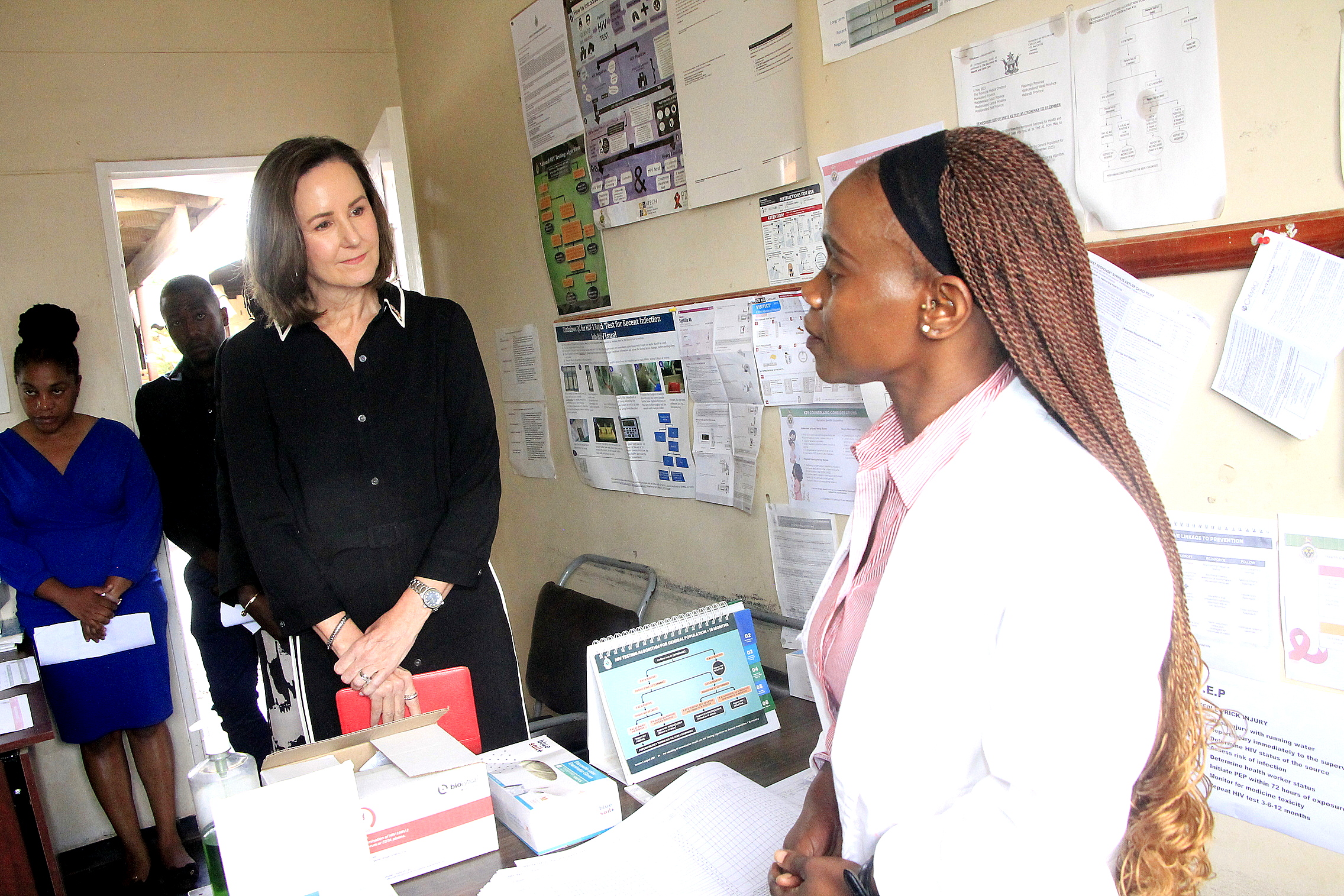
United States Ambassador Pamela Tremont accompanied by Dr Mugurungi and other health officials today visited Epworth Overspill Clinic, commending frontline health workers and highlighting new innovations aimed at strengthening HIV prevention in Zimbabwe.
Addressing clinic staff and community members on Thursday afternoon, Ambassador Tremont thanked the team for their commitment to delivering lifesaving services in one of Harare’s fast-growing settlements. She said the visit was an opportunity to learn from Epworth’s early experience as one of the first facilities in the country to introduce lenacapavir, a new HIV prevention option she described as “groundbreaking.”
The ambassador noted that lenacapavir, developed by U.S.-based biopharmaceutical company Gilead Sciences, is already being rolled out in the United States, as well as parts of southern Africa including Zambia and Eswatini. She described the drug as a major advancement that offers people at risk of acquiring HIV a safe, discreet, and highly effective prevention option.
“This is what American innovation in global health looks like,” she said. “Saving lives, removing barriers to care, and strengthening partnerships that expand access to cutting-edge treatment and prevention tools.”
Ambassador Tremont announced that the United States plans to support access to lenacapavir for approximately 271,000 Zimbabweans over the next three years. Health experts estimate this could prevent more than 9,000 new HIV infections, helping the country sustain progress made over decades of investment in HIV response programmes.
She highlighted that the American people have contributed more than US$1.9 billion toward HIV/AIDS programmes in Zimbabwe, supporting testing, treatment, prevention, and health systems strengthening. These investments, she said, have helped the country achieve the UNAIDS 95-95-95 targets — a global benchmark indicating that most people living with HIV know their status, are on treatment, and have suppressed viral loads.
The ambassador emphasized that partnerships between Zimbabwe and the United States are evolving beyond traditional aid models toward collaboration focused on sustainability and self-reliance. She praised the Government of Zimbabwe and local healthcare workers for rapidly adopting new technologies and maintaining momentum in the fight against HIV.
She concluded by appreciating health professionals across the country for their dedication and reaffirmed U.S. commitment to supporting resilient health systems that can respond to future public health challenges.
Zimbabwe’s introduction of lenacapavir is a significant milestone in HIV prevention. The long-acting injectable drug, administered only twice a year, provides a discreet alternative to daily oral pre-exposure prophylaxis (PrEP). Health officials say this makes it especially valuable for populations that face stigma, adherence challenges, or limited access to regular healthcare visits.
The launch in Zimbabwe positions the country among early adopters globally, reflecting confidence in its public health infrastructure and HIV programming. Health authorities worked with international partners and local clinics like Epworth Overspill to prepare staff, educate communities, and ensure safe rollout protocols. The introduction is expected to complement existing prevention tools such as condoms, testing services, and antiretroviral treatment.
Public health leaders believe lenacapavir could be a game-changer in reducing new infections if scaled effectively. By expanding prevention choices and simplifying adherence, the rollout is expected to strengthen Zimbabwe’s efforts to maintain epidemic control and protect future generations from HIV.


