
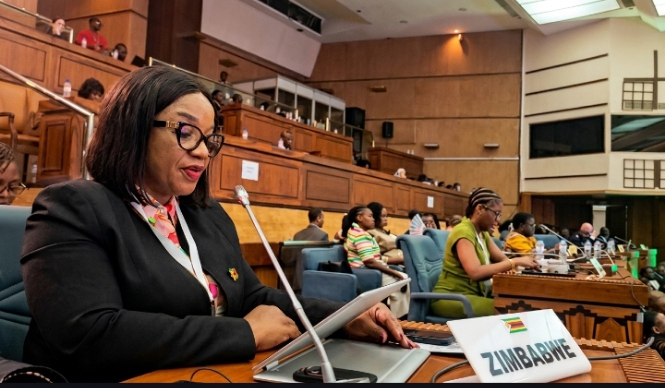
Zimbabwe has set out the steps it has taken, and the path it is considering, to address the legal, medical and social vulnerabilities faced by intersex people, telling a continental human rights forum that regional commitments are not diplomatic paperwork but an urgent “call to action.”
Mrs V. Nyemba delivered the address on behalf of the Republic of Zimbabwe at a side event on the margins of the 89th Ordinary Session of the African Commission on Human and Peoples’ Rights (ACHPR). Titled “Advancing Intersex Rights, Recognition, Law, Policy and Data in Africa: Implementing ACHPR/Res.552,” the event was jointly hosted by the Zimbabwean Government, the United Nations Development Programme (UNDP) and the Intersex Community of Zimbabwe (ICZ). It drew human rights defenders, legal experts and state representatives from across the continent and beyond.
Speaking to a packed room, Nyemba stressed Zimbabwe’s obligations as a State Party to the African Charter on Human and Peoples’ Rights. She named ACHPR Resolution 552, the regional text dedicated to the promotion and protection of intersex individuals, as the main framework guiding the country’s ongoing legislative review.
“Our Constitution, adopted in 2013, places dignity, equality and non-discrimination at the centre of our legal order,” she said, linking the government’s initiatives to the national philosophy of “Leaving No Place and No One Behind,” championed by President Dr Emmerson Mnangagwa.
She traced the process back to 2022, when Zimbabwe formally accepted international recommendations to protect intersex children from harmful, irreversible medical practices and bodily violations. Promises made abroad, she argued, must be tangible at home. “A commitment made at the international level has to be felt in a clinic, a school, a registry office, and a family home,” she said.
Civil society delegates welcomed the candour with which the delegation presented findings from national consultations and legal research carried out over recent years. The research concluded that while the 2013 Constitution offers a progressive foundation, general guarantees fall short for marginalised groups when specific administrative procedures are missing.
The government’s assessment identified four structural gaps. The first is the absence of express legal recognition: intersex people are not explicitly acknowledged in Zimbabwean law, and changing identity markers or correcting birth records remains arduous and heavily dependent on medical gatekeeping. Inconsistent practice leaves many families unaware that legal routes to modification exist at all.
The second concerns bodily integrity. Zimbabwe has no explicit statutory ban on non-consensual, medically unnecessary surgeries on intersex infants and children, and such interventions continue, driven by social pressure rather than clinical need, without standardised medical management guidelines for practitioners.
The third is stigma and institutional exclusion. Testimonies from intersex individuals and their families described bullying, school dropout, barriers to formal employment and entrenched stigma in public health facilities. State organs also lack basic protocols, including guidelines for detaining intersex persons in the correctional system.
The fourth is a data void. National statistical frameworks record only “male” or “female,” leaving intersex people uncounted and effectively invisible in state planning, which makes targeted budgeting and resource allocation nearly impossible.
“The overall lesson,” Nyemba said, “is that the problem is not just what the law says, but how it works in practice.”
To address these shortcomings, the government convened a national dialogue in August 2026, bringing decision-makers from across the state together to turn research into policy options. Priorities now before Cabinet include civil recognition that does not depend on invasive surgical requirements, clear legal protection for children against non-consensual surgery, comprehensive civil registry protocols and rights-based data collection.
The delegation was careful to temper expectations, however, stressing that no legislative changes have been finalised. “These are priorities under consideration… No Government decision on reform has yet been taken,” Nyemba said, underlining the deliberative character of the process.
Closing her address, she said Zimbabwe had come to Dakar not only to present its progress but to learn from African peers who have navigated comparable legal transitions. Policy, she added, must be shaped by lived experience. “No single ministry or government can do this alone. No policy on intersex persons should be designed without intersex persons.”
At the 89th Ordinary Session, the delegation’s frank self-assessment is being viewed by participants as a notable example of state accountability on bodily autonomy, dignity and legal inclusion across the continent.


