
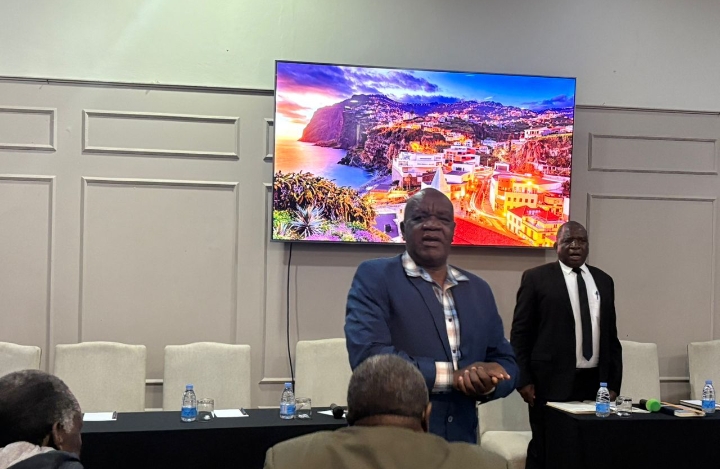
Justice, Legal and Parliamentary Affairs Minister Ziyambi Ziyambi has challenged the Zimbabwe National Liberation War Veterans Association to turn its revival into a new chapter of unity, accountability and economic empowerment while placing the welfare of veterans at the centre of its mandate.
Through his speech which was read in his absence at the Association’s Annual General Meeting (AGM) in Harare on Saturday, Minister Ziyambi described the occasion as the organisation’s “institutional rebirth, saying its revival should go beyond an administrative milestone to reaffirm the country’s debt to those who fought for independence.
The speech read that Zimbabwe’s sovereignty and national identity were rooted in the sacrifices made by liberation war fighters.“Your revolutionary contribution is not a mere footnote in our history. It is the absolute bedrock of our national identity,” .
He, however, warned that honouring the liberation struggle could not be confined to commemorations and speeches, arguing that national gratitude must be translated into tangible improvements in the lives of veterans and their families.
“To remember is to take moral weight… [and] must be accompanied by tangible delivery and sustained efforts to absolutely guarantee, preserve the security [and] secure the social, economic standing of those who took up arms for our freedom,” he said.
He mentioned that the welfare of liberation war veterans was not a matter of charity, but a constitutional responsibility.
He pointed to Section 22 of the Constitution of Zimbabwe, which places obligations on the State and its institutions to accord due respect, honour and support to veterans of the liberation struggle.
“Social security and material welfare are not charitable handouts, they are a sacred constitutional right and a national obligation that safeguards an undeniable, unbreakable shield for human dignity,” he said.
His remarks come as the Association’s national chairman, Cde E. Moffat Marashwa, told the AGM that the organisation was advocating for improved pensions and medical aid for its members.
Marashwa said the current monthly pension was inadequate and disclosed that the Association was engaging relevant Government departments on improving veterans’ welfare.
The minister urged the revived Association to complement Government’s economic programmes by creating sustainable commercial opportunities for liberation war veterans.
He challenged the leadership to forge strategic partnerships across key sectors of the economy, including agriculture, mining, small and medium enterprises, cooperatives, housing and infrastructure.
In agriculture, he called for veterans to be supported with inputs while participating in commercial farming, agro-processing and value addition.
“In mining, formalizing syndicates and asset claims, so that veterans participate directly within the immense mineral wealth beneath our soil,” he said.
He also advocated for community-level industries through SMEs and cooperatives, as well as structured housing schemes that would provide long-term shelter and estate security for veterans and their families.
“Government stands resolute and is fully prepared to partner with an organization legally compliant and structured association to ensure that these economic blueprints are converted into real lives,” Ziyambi said.
The minister’s call dovetails with the Association’s own plans. Marashwa said the national executive had been engaging stakeholders to mobilize resources for mining and agricultural initiatives, including implements for members.
He also announced plans to shift veterans’ projects from a cooperative-based model towards a family-based approach, taking into account the advanced age of liberation war veterans.
The Minister’s’s address also placed a strong emphasis on unity, coming against the backdrop of the Association’s recent legal and institutional challenges.
Marashwa said the current leadership’s tenure had been characterized by legal battles that prevented the Association from holding its AGM in 2025 and fulfilling some constitutional mandates.
He said the Association had successfully defended itself in cases before the High Court and Supreme Court, with one High Court matter still pending.
Despite those challenges, Marashwa said the national executive had continued working on programmes aimed at improving members’ welfare.
Ziyambi urged the organisation to now put its divisions behind it. “Let this day draw a definite line in the sand. Let it mark the absolute end of institutional fragmentation, factional disputes, and the personality-driven divisions,” he said.
“This association belongs entirely to the veterans… It must henceforth be governed by its constitutional rules.”
He said disagreements were inevitable in any organisation, but should be addressed through dialogue, constitutional processes and mutual respect rather than public confrontation.
“Use this revived platform to heal our fractures, to heal all fractures, not to deepen them,” he said.
Saturday’s gathering was the Association’s first AGM since the current leadership was elected in 2024
Marashwa expressed gratitude to President Emmerson Mnangagwa, the Association’s patron, for his support and guidance, and thanked Minister Ziyambi for accepting the invitation to attend as guest of honour.
He also acknowledged the presence of the Registrar of Private Voluntary Organisations and other officials and stakeholders.
The chairman said the Association had continued to engage stakeholders despite its legal difficulties, including efforts to secure office accommodation at national, provincial and district levels.
The decentralisation programme, he said, would expand the organisation’s footprint and improve accessibility for members.
The Association also plans to embark on a nationwide membership mobilisation exercise over the next 12 months, visiting provinces and districts to assess and strengthen its membership base.
Monthly subscriptions remain at a minimum of US$2 or its equivalent in local currency, which Marashwa said was intended to keep membership affordable for veterans.
He challenged Marashwa and the National Executive Committee to recognize the historic responsibility entrusted to them and build an institution characterized by accountability, inclusivity and a sustained focus on veterans’ welfare.
“You have been entrusted with a profound and historic responsibility: the collective voice, the aspirations, and the long-term welfare of veterans [and their] families now rest squarely upon you,” he said.
He urged the leadership to demonstrate statesmanship and integrity and leave behind a disciplined and enduring institution that reflects the principles of the liberation struggle.
Marashwa echoed the call for unity in his closing remarks, urging members to remain committed to the Association’s welfare mandate and **“shun all forms of mechanisms which are divisive in nature.
The AGM therefore emerged as a significant attempt to reposition the Zimbabwe National Liberation War Veterans Association around three central priorities: unity and institutional stability, improved welfare, and meaningful economic participation for veterans and their families.


