
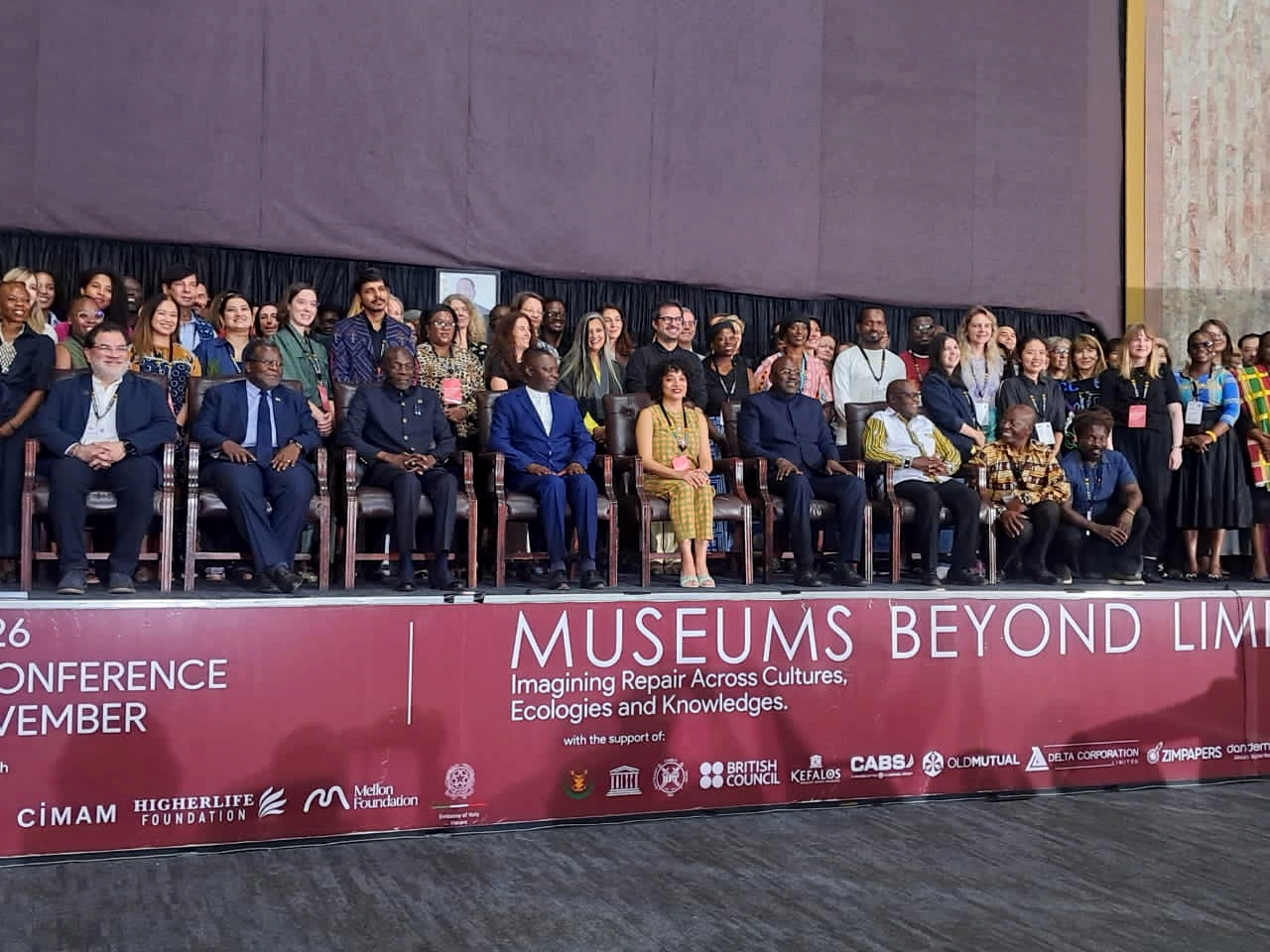
Museums are not a luxury reserved for wealthy nations but the infrastructure of civilisation itself, President Emmerson Mnangagwa said today as the International Committee for Museums and Collections of Modern Art (CIMAM) opened its annual conference in Harare, the first time the gathering has been held in Africa since its formation.
The President’s keynote address was delivered at the Harare International Conference Centre (HICC) by Minister of Sport, Recreation, Arts and Culture, Lieutenant General (Rtd) Ambassador Anselem Sanyatwe, who read it on his behalf. Neither the President nor his deputies attended the event. The prepared text had named Vice President Dr K.C.D. Mohadi as the President’s representative, but the speech was read out by the Minister.
Delegates are gathering under the theme “Museums Beyond Limits: Imagining Repair across Cultures, Ecologies, and Knowledges.” In the address, the President said the theme was well suited to examining the past of collections, the future of collecting and the way museums will operate in years to come.
He praised CIMAM for engaging the continent and said the exchange between the organisation, the National Gallery of Zimbabwe (NGZ) and stakeholders would shift the paradigm of practice in the foreseeable future. He noted that CIMAM was formed in 1962, the same year the National Gallery hosted the First International Conference on African Cultures, and that the conference arrives in the 69th year of the Gallery’s incorporation.
Opening with the question “What is a museum?”, the President argued that a museum is a living institution holding the moral, intellectual and creative imagination of a people. He said museums act as an antidote in an era shaped by artificial intelligence, social media and climate change, the first of which is rewriting the nature of work while the second threatens to flatten cultural diversity into a single scrollable feed.
He framed the 21st-century museum across three dimensions: an identity archive, an economic engine and a democratic space.
On identity, he pointed to Ndebele beadwork and the Zimbabwe Bird, the soapstone emblem that gave the nation its name, as evidence that Africans built, created and governed long before colonial contact. In a world where disinformation spreads faster than truth, he said, verified and preserved collections are among a nation’s most powerful tools.
On the economy, the President said culture is revenue as well as soft power, citing a global creative economy valued at over US$2.25 trillion that employs nearly 30 million people. Heritage-driven tourism, he added, is among the fastest-growing sectors in global travel, and a blockbuster exhibition fills hotels, restaurants, transport networks and shops across a whole city.
On democracy, he said museums must be honest about past failures, noting that many institutions were built in the colonial era and still hold objects and narratives shaped by that unequal encounter. The museum CIMAM should champion, he said, democratises access, invites communities to take part in curatorship and celebrates the full complexity of human experience. A museum that serves only the elite, he warned, becomes a monument and a white elephant.
He said the government’s commitments are not rhetorical, comparing its approach to that of Singapore in the 1990s and South Korea’s Hallyu strategy, both of which treated culture as a form of power, prosperity and pride.
Tying the vision to the National Development Strategy 2 (NDS2), the President described a future in which a young girl from Binga can walk into a world-class museum in Bulawayo and see her community’s traditions honoured alongside great art from around the world, and a young man from Mbare can build a sustainable livelihood as an artist. “It is not a dream, it is a plan,” he said.
The President thanked sponsors, partners, CIMAM patrons and the Higherlife Foundation, saying their footprint was an enduring legacy for world cultural heritage and for Zimbabwe, and pledged that the Second Republic would keep partnerships alive in all its activities. He also directed that the National Gallery’s membership of CIMAM “must stand guaranteed” and urged the Ministry of Sport, Recreation, Arts and Culture to continue supporting its agencies and pursuing international engagement and re-engagement through museum spaces.
Looking beyond the sessions, he encouraged delegates to use the afternoon visits to creative hubs and the post-conference excursions to sample Zimbabwe’s arts, cuisine and hospitality. He commissioned them as “Zimbabwean Ambassadors” who should return as repeat visitors and bring others with them, adding that Zimbabwe “is an enemy to none and a friend to all.”
The address was delivered before a gathering that included Cabinet ministers, deputy ministers, permanent secretaries, members of the diplomatic corps, CIMAM Executive Board President Amanda De La Garza Mata and her board, National Gallery Board of Trustees chairman (Rtd) Justice Maphios Cheda, and NGZ chief executive Raphael Chikukwa. Higherlife Foundation representative Tsitsi Masiyiwa and The Mellon Foundation were also acknowledged in the programme.
The keynote speech ended with declaring the conference officially opened.


