
STAFF REPORTER
India’s 77th Republic Day celebrations in Harare revealed how diplomacy, enterprise and people-to-people ties continue to shape the India–Zimbabwe relationship.
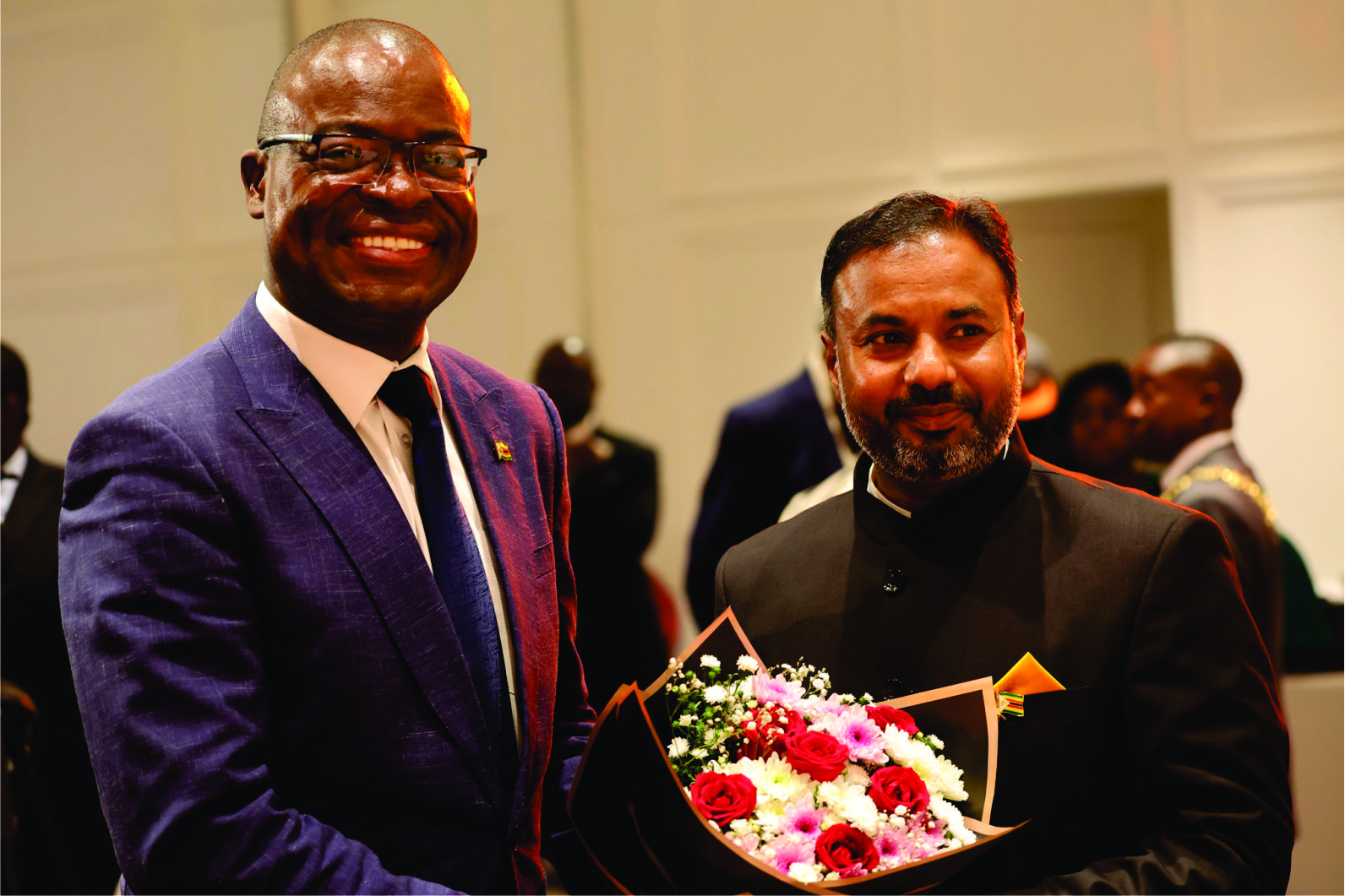
Speaking at the Hyatt Regency Meikles, India’s Ambassador to Zimbabwe, H.E. Shri Bramha Kumar, described Republic Day as a defining chapter in India’s constitutional journey. “Republic Day marks the coming into force of the Constitution of India, embedding the values of democracy, pluralism, secularism and natural justice that continue to guide our national life,” he said, noting that these principles remain central to India’s domestic and international engagement.
The Ambassador said India’s rapid progress across digital technologies, science and innovation, space exploration and healthcare reflects a development model anchored in inclusion and resilience. “India’s growth is not only about economic indicators, but about building systems that improve lives and contribute meaningfully to global development,” he said.
Turning to bilateral relations, Ambassador Kumar highlighted the depth of ties between India and Zimbabwe, now spanning 46 years. “Our relationship is rooted in history and mutual respect, and it continues to evolve through strong economic and developmental cooperation,” he said. Indian private sector investment in Zimbabwe, estimated at about US$600 million, was cited as a practical demonstration of confidence. “Indian companies remain committed to Zimbabwe’s growth, supporting value addition, job creation and long-term partnerships.”
Zimbabwe’s Minister of Foreign Affairs and International Trade, Hon. Prof. Amon Murwira, said the relationship aligns closely with Zimbabwe’s constitutional values and
development agenda. “Our foreign policy is guided oreign policy is guided by the Constitution, which places international cooperation at the centre of national development,” he said. “India is a natural partner because our engagement is based on mutual respect, shared values and tangible outcomes.”
Prof. Murwira emphasised that diplomacy must deliver results. “Diplomacy is not ceremonial; it must translate into concrete benefits for our people,” he said, pointing to cooperation in agriculture, renewable energy, education, science and technology. He also commended India’s approach to South–South cooperation, noting its emphasis on partnership rather than dependency.
As the celebrations concluded, the occasion stood as both a commemoration of India’s republican journey and a reaffirmation of a partnership shaped by history, strengthened by cooperation and oriented towards shared development. PHOTOS: MOFAIT


