
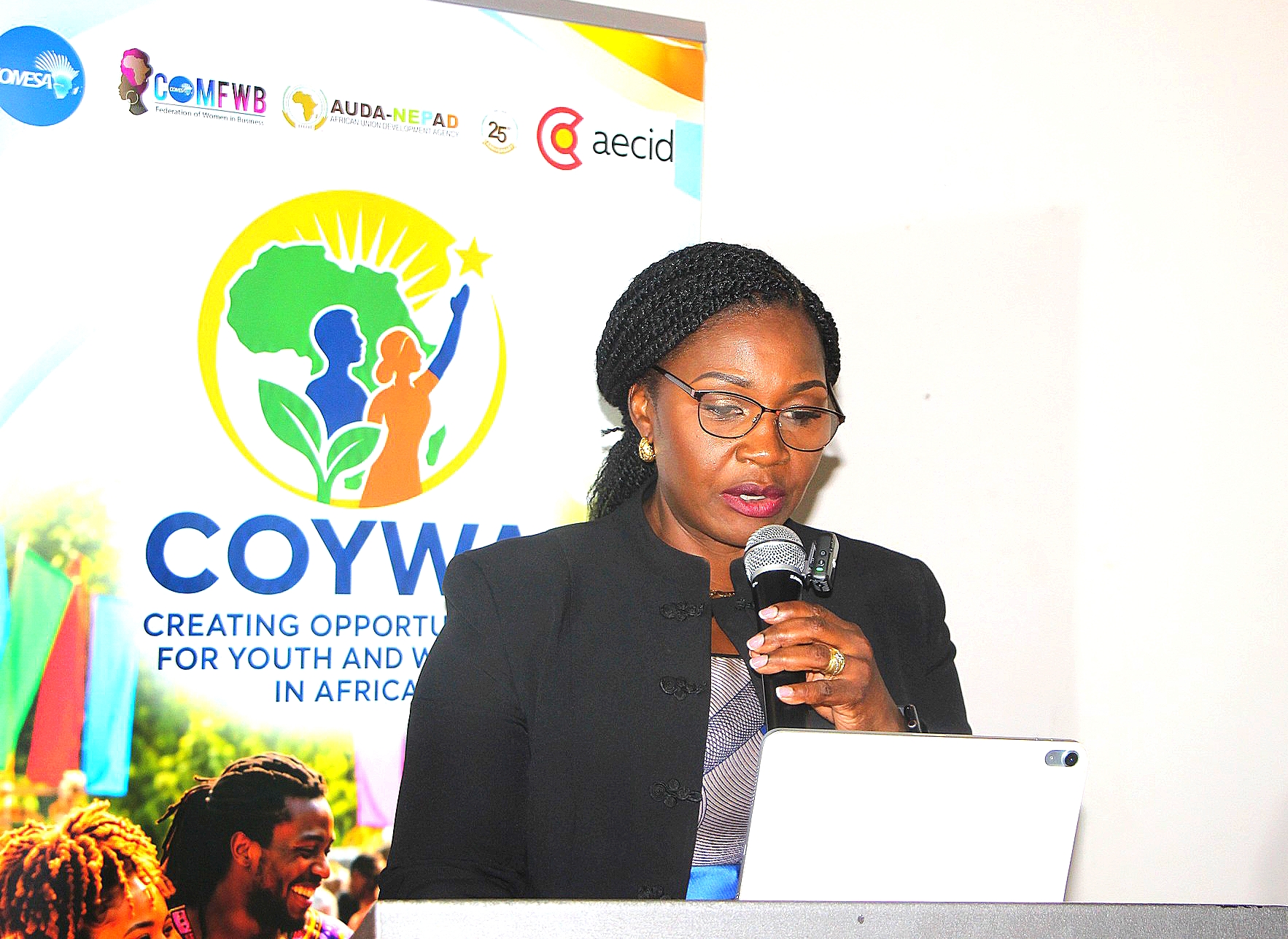
Women and young entrepreneurs across the COMESA region will gain access to training, funding and buyers through a network of incubation hubs, as the Creating Opportunities for Youth and Women in Africa (COYWA) programme moves into its delivery phase.
“The promise of the AfCFTA will only be fully realised when women and young entrepreneurs are equipped to participate meaningfully in regional value chains, access larger markets and benefit from the opportunities of African economic integration,” said Daphne Muzawazi, a representative of the African Union Development Agency (AUDA-NEPAD), at a side event held in the Jacaranda Room at the Harare International Conference Centre.
COMESA Federation of Women in Business (COMFWB) Zimbabwe chairperson Edna Mukurazhizha set out four priorities for the programme: closer policy partnerships, more incubation hubs, easier access to finance and dependable market links. She urged governments, regional economic communities and continental institutions to weave COYWA into national and regional development plans.
Mukurazhizha also pressed for flexible funding, naming loans with lighter collateral demands, start-up grants, blended financing and credit guarantee schemes as remedies for founders shut out of conventional bank lending. She added that incubated firms must be linked to buyers, distributors and investors through trade fairs, digital marketplaces and cross-border commercial networks.
Incubation is among the programme’s main pillars. Each participating region receives about €950,000 for innovation, management training and related assistance, according to programme information. The hubs are anchored in Kenya, Ethiopia, Seychelles and Zimbabwe, and offer business advisory support, product testing, financial management, marketing and technical training. Their work spans agribusiness, food testing, leather production and textiles, while a digital literacy component prepares youth and women-led ventures for e-commerce and financial technology.
Muzawazi said COYWA stands apart because it is delivered through regional economic communities, which brings it nearer to participating countries and lets it reach beneficiaries directly. She pointed to the gap between what schools produce and what employers want, noting that self-employment offers young people another route into the economy. She also tied the programme to the African Continental Free Trade Area and to two aspirations of the African Union’s Agenda 2063, namely inclusive prosperity and people-driven growth that draws on women and youth.
Looking beyond the five-year implementation period, Muzawazi said AUDA-NEPAD wants to explore ways of extending the programme and readying entrepreneurs for the next decade, with technology and artificial intelligence already reshaping how young founders start and run their ventures. As AUDA-NEPAD marks its 25th anniversary, she stressed that partnership is essential.
“No single institution can achieve these ambitions alone,” she said, urging that the launch be remembered “not merely as the beginning of another programme, but as a commitment to turn entrepreneurial potential into sustainable businesses, decent employment and greater economic opportunities across the COMESA region.”
COYWA is implemented through COMFWB under a partnership between the Common Market for Eastern and Southern Africa (COMESA) and AUDA-NEPAD. It builds on earlier efforts to empower women entrepreneurs and strengthen micro, small and medium enterprises, with particular attention to barriers that limit their role in regional trade.
The side event brought together government representatives, business leaders and regional development partners. A representative of Zimbabwe’s Ministry of Women Affairs, Community and Small and Medium Enterprises Development praised COMFWB and its partners for backing women and young people in business.


