

*Bard Santner Microfinance Bank has unveiled a 13-member board comprising financial services executives, corporate governance specialists, banking professionals and regulatory experts from Zimbabwe, South Africa, Mauritius, India and the United Kingdom, as the newly launched institution seeks to establish itself in the country’s diaspora-focused financial services market.
The appointments follow the bank’s launch last week and mark a significant step in its ambition to connect Zimbabweans living abroad with financial services, local businesses and investment opportunities back home.
The institution is positioning itself to tap into the multi-billion-dollar remittance market through a digital-first model designed to facilitate cross-border financial transactions while supporting small and medium-sized enterprises (SMEs) and investment initiatives.
The composition of the board places considerable emphasis on corporate governance, regulatory compliance, financial management and depositor protection, issues that remain central to confidence in Zimbabwe’s banking sector following previous episodes of institutional failure, mismanagement and economic instability.
The board brings together international financial expertise and experience in Zimbabwe’s domestic banking environment, with executive, non-executive and independent directors expected to provide strategic leadership and oversight.
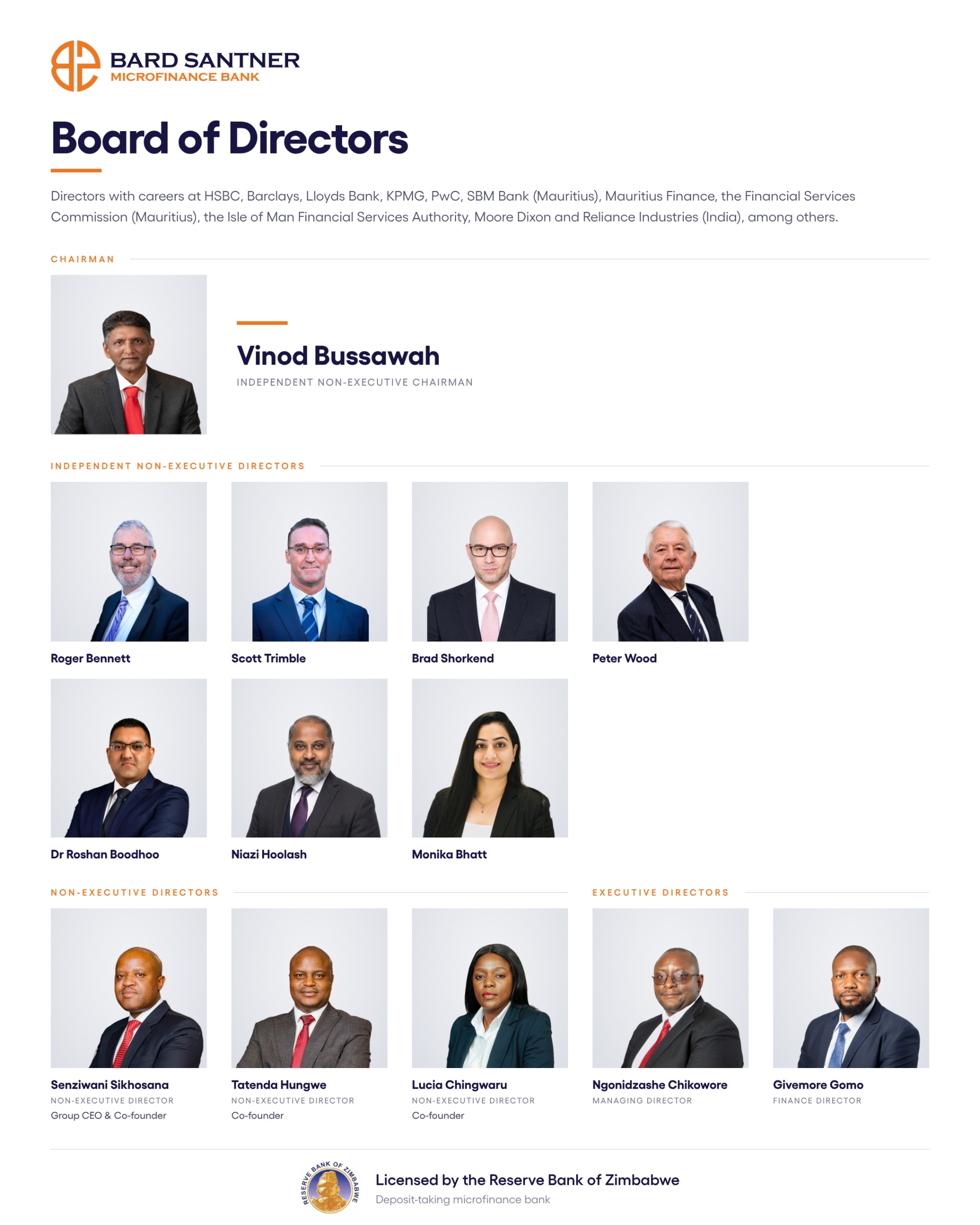
Vinod Bussawah has been appointed chairman, supported by independent directors Roger Bennett, Scott Trimble, Brad Shorkend, Peter Wood, Dr Roshan Boodhoo, Niazi Hoolash and Monika Bhatt.
The non-executive directors are Senziwani Sikhosana, Tatenda Hungwe and Lucia Chingwaru, while Ngonidzashe Chikowore serves as managing director and Givemore Gomo as finance director.
Bussawah, a Fellow of the Association of Chartered Certified Accountants, brings more than 30 years of experience in finance and corporate governance. He also chairs audit committees at two listed companies, adding experience in financial oversight and accountability to the institution’s leadership structure.
“Our job as a board is simple: to protect depositors’ money and to make sure the bank is run to international standards,” Bussawah said.
His remarks underscore the importance of establishing strong internal controls and transparent decision-making processes as the institution develops its operations in a market where public confidence in financial institutions has been repeatedly tested.
Another prominent appointment is Dr Boodhoo, the former chief executive of Mauritius’ Financial Services Commission and former deputy chief executive of SBM Group, one of the island nation’s major banking groups.
He also serves on the board of a Nasdaq-listed company, bringing experience spanning financial regulation, banking leadership and international corporate governance.
Trimble contributes approximately three decades of senior and board-level experience across HSBC, HBOS, Grant Thornton, Moore Global and the Isle of Man financial regulator.
He was named UK Anti-Money Laundering Advisor of the Year in 2022 and 2023, according to the information provided by the institution.
His background is particularly relevant to a business model involving cross-border transactions, where financial institutions must maintain robust safeguards against money laundering, illicit financial flows and other compliance risks.
Bennett brings four decades of experience in banking and trust services, including positions associated with Lloyds Bank, Canada Trust and CIBC. He is also the founder of Fortress Management Services in the Isle of Man.
Hoolash, a former associate director at KPMG and senior manager at PwC, has experience in financial restructuring, including central-bank-mandated restructuring processes involving commercial banks.
His professional background adds expertise in financial risk management and institutional recovery to the board.
Shorkend, an adjunct faculty member at the Gordon Institute of Business Science and Duke Corporate Education, advises leadership teams across Europe, the United States, Asia, the Middle East and Africa.
Bhatt specialises in company secretarial practice, corporate law and governance, providing additional expertise in board processes, legal compliance and institutional accountability.
The international appointments are complemented by local banking experience through Peter Wood, the former chairman of BancABC Zimbabwe, whose knowledge of the domestic market is expected to contribute to the bank’s strategic positioning.
The inclusion of professionals with experience in different jurisdictions reflects the challenges facing an institution seeking to serve customers across borders while operating within Zimbabwe’s regulatory framework.
For a diaspora-focused financial services provider, the ability to meet customer identification requirements, maintain appropriate anti-money laundering controls and demonstrate sound governance will be critical to establishing relationships with international financial partners.
The board also includes three non-executive directors associated with the founding of Bard Santner Inc: Sikhosana, Hungwe and Chingwaru.
They are expected to help safeguard the founding vision and guide the institution’s strategy, working alongside the executive team responsible for daily operations, financial management and commercial performance.
Sikhosana, who has extensive experience in Zimbabwe’s banking and financial services sector, also serves as chief executive of the group. He was recently honoured as the 2026 Director of the Year by the Institute of Directors Zimbabwe.
His leadership role places him at the centre of the group’s ambition to develop a financial services institution that combines local market knowledge with digital innovation and international governance standards.
Chikowore said the decision to bring together professionals from different markets was intended to establish credibility and build the institution on a strong governance foundation from the outset.
“Zimbabweans deserve a new fintech institution they can trust. That is why we brought together experts with great track records, locally, regionally and internationally, alongside people who know this market well, to build a new diaspora-focused institution from scratch.
“We want to lay a strong foundation, ensure corporate governance and protect depositors’ funds from the word go,” he said.
The managing director’s remarks place depositor protection and institutional credibility at the centre of the bank’s development strategy, as it seeks to distinguish itself in a competitive financial services environment.
Sikhosana said confidence in financial institutions depended on consistent service delivery, security, transparency and the responsible handling of customers’ money and personal information.
“Banks are founded on trust. Trust in banking is gradually earned through customer-centred, efficient and consistent service, security, and transparency.
“Trust and the interplay of confidence and accountability become the nerve-centre of banking. This entails a deep responsibility to protect both depositors’ funds, confidentiality and data.
“When customers choose a bank, they are not just choosing a name or brand; they are entering a confidential relationship built on the legitimate expectation of safety of their funds, confidentiality of their information and ethical behaviour,” he said.
His comments highlight the importance of customer protection as financial services increasingly move towards digital platforms, where accessibility and transaction speed must be matched by reliable security systems and effective oversight.
The bank’s strategy comes at a time when technological change is reshaping the traditional banking model. Digital platforms are enabling financial institutions to reach customers beyond the physical branch networks that historically defined their size and market presence.
For emerging institutions, competitiveness increasingly depends on the usefulness of their services, operational efficiency, customer experience and ability to manage risks while maintaining sustainable profitability.
Bard Santner’s proposed digital-first approach seeks to capitalise on these developments by connecting Zimbabweans abroad with financial services and opportunities in their home market.
However, operating across multiple jurisdictions also presents complex regulatory and operational demands. Customer verification, transaction monitoring, data protection and compliance with applicable financial regulations will be essential to building sustainable relationships with customers and international banking partners.
The separation of executive management from independent board oversight is intended to strengthen accountability and reduce the risks associated with rapid expansion without adequate internal controls.
Independent directors can provide scrutiny of management decisions, while audit and governance structures help ensure that institutional growth is supported by sound financial reporting, risk management and compliance procedures.
These safeguards are particularly important in a sector where failures in governance can undermine depositor confidence and threaten institutional stability.
Zimbabwe’s diaspora represents an important source of household income, foreign currency and investment potential. A financial institution capable of connecting diaspora resources with productive domestic activity could help broaden access to financial services and create additional channels for supporting local enterprises.
Bard Santner is seeking to position itself within this market by developing financial connections between Zimbabwe and diaspora communities, particularly in countries such as South Africa, the United Kingdom and the United States.
Its broader ambition is to channel part of the remittance market towards structured investment opportunities while providing services to individuals and businesses.
Realising that ambition will depend not only on technology and market reach but also on the institution’s ability to demonstrate financial resilience, regulatory compliance and dependable customer service.
The unveiling of the board therefore signals an effort to establish the governance structures necessary for the bank’s long-term development.
With experience spanning banking, auditing, financial regulation, corporate law and executive leadership, the directors bring a broad range of professional backgrounds to the institution.
Their collective task will be to translate that expertise into effective oversight, responsible management and services that meet the needs of customers at home and abroad.
As Bard Santner begins building its position in Zimbabwe’s financial services market, its success will ultimately be measured by its ability to protect customers, maintain confidence, comply with applicable regulations and deliver practical financial solutions.
For an institution seeking to connect diaspora capital with domestic economic activity, the board’s challenge will be to ensure that international expertise and digital ambition are matched by transparent governance, operational discipline and sustained public trust.


