
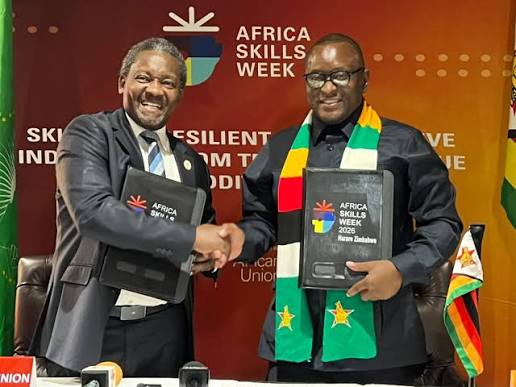
African Union officials, governments and development partners have called for increased investment in technical and vocational education, stronger industry partnerships and measurable national implementation of continental skills policies as the third Africa Skills Week concluded in Harare on Friday.
The five-day gathering, held from 12 to 16 October 2026 under the theme “Skills for Resilient and Competitive African Industries: From Training to Value Creation,”1 brought together policymakers, educators, industry representatives, development partners, innovators and young people to examine how skills development can accelerate industrialisation, employment creation and economic transformation across Africa.
The closing proceedings focused on translating commitments into practical action, strengthening cooperation between governments and industry, expanding apprenticeships and mobilising sustainable financing for education and skills development.
The programme included the presentation and adoption of the Africa Skills Week 2026 Communiqué by Ambassador R. M. Chitiga, Secretary for Skills Audit and Development, a partner statement by Canada’s Ambassador to Zimbabwe, His Excellency Jeff Senior, and closing remarks by the African Union Commission’s Commissioner for Education, Science, Technology and Innovation, Professor Gaspard Banyankimbona.
The host country was also scheduled to deliver the vote of thanks and handover through the Minister of Foreign Affairs and International Trade or his representative, formally bringing the third edition to a close.
In his closing remarks, Professor Banyankimbona expressed gratitude to Zimbabwe’s President Emmerson Mnangagwa, the government and the people of Zimbabwe for hosting the continental gathering, while emphasising the importance of translating the week’s deliberations into a coordinated framework for implementation.
He said the Compact of Action developed through the meeting should guide governments, regional institutions, the private sector and development partners in converting continental commitments into measurable national outcomes.
“However, the true test of our efforts begins with this Compact. I therefore invite us to translate this framework into a practical commitment with clearly defined priority areas, institutional responsibilities and realistic timelines. The African Union embraces its role within this framework of collective responsibility, working hand in hand with Member States, Regional Economic Communities, the private sector and our development partners.
“We will work to sustain the momentum generated during this week. We will support national action plans, connect financing pipelines and strengthen the accountability mechanisms required to translate our continental strategies into tangible national results.”
Professor Banyankimbona said the African Union would continue supporting national implementation plans and efforts to mobilise financing, stressing that the effectiveness of continental strategies would ultimately depend on their application within individual countries.
He also called for the discussion on education and skills development to be elevated to the highest political level, proposing a biennial African Education and Skills Summit bringing together Heads of State and Government, relevant ministers and industry leaders.
The proposed summit would provide a platform for strengthening political accountability, mobilising long-term investment and accelerating results in education, skills development and industrial transformation.
He commended Zimbabwe for demonstrating the importance of African-led solutions and acknowledged development partners for aligning their support with continental priorities.
“To Zimbabwe, thank you for reminding us that African solutions must be shaped by African hands and minds.
“To our development partners, thank you for consistently aligning your support with our continental priorities. Canada, in particular, has provided an example of such alignment.
“And to the young women and men of Africa, we see your ambition, recognise your potential and remain committed to building the future with you.”
The commissioner said the success of Africa Skills Week should ultimately be assessed through tangible improvements in apprenticeships, enterprise development, industrial capacity and partnerships rather than the discussions held during the event alone.
“Africa Skills Week 2026 in Harare should be remembered for the apprenticeships we expanded, the enterprises we enabled, the partnerships we forged, the industries we strengthened and the transformations we set in motion.
“We must now move decisively together, turning our shared aspirations into practical action and advancing our guiding ambition of moving from skills development to value creation.”
He thanked the Government of Zimbabwe, the African Union Commission, development partners and participants for their contributions to the gathering.
Canada reaffirmed its commitment to supporting African education and technical and vocational training, with Ambassador Jeff Senior highlighting the importance of connecting training to employment, entrepreneurship and productive economic activity.
Senior, who said he had presented his credentials in Zimbabwe only the previous day, described his participation in the closing ceremony as an opportunity to begin his official engagement through discussions on education, skills and opportunities for young people.
He congratulated the Zimbabwean government and the African Union Commission on hosting the event, saying the gathering had created opportunities for policymakers, educators, industry leaders and young people to exchange knowledge and develop practical responses to common challenges.
“Across Africa, countries are working to create jobs, strengthen industries, expand value chains and build inclusive economies. Achieving those ambitions requires investment, innovation and entrepreneurship, but it also requires people. People with the skills, knowledge and capabilities to drive growth and transformation.
“Skills development is therefore not only an educational priority; it is an economic imperative. It enables young people to access opportunities, businesses to become more productive and competitive, supports entrepreneurship and innovation, and helps countries harness the full potential of their greatest asset, which is human people.”
The ambassador said Canada regarded education, technical and vocational training, and skills development as important components of its engagement with African countries.
He noted that skills systems were most effective when they established clear links between education and economic opportunities, enabling graduates to participate in productive industries and helping enterprises improve their competitiveness.
“Skills are most powerful when they connect learning to opportunity. Through Canada’s Africa Strategy, we are working to strengthen partnerships that advance shared prosperity, support economic growth and create opportunities for mutually beneficial economic cooperation.
“Our partnership with the African Union Commission reflects that commitment. Under our current partnership, Canada is providing $20 million in support of the African Union Commission, including $10 million dedicated to AU-led technical vocational education and training commissions.”
Senior said Canada was pleased to support the work of the African Union Commission’s Department of Education, Science, Technology and Innovation in advancing education, youth employment and stronger connections between training institutions, industry and economic opportunities.
He added that the success of Africa Skills Week would depend on what governments and their partners did after the event, particularly in implementing commitments and equipping young people with the competencies required by growing economies.
“As Africa Skills Week comes to a close, the real measure of success will be what follows: strengthened partnerships, continued collaboration, concrete action to equip young people with the skills they need to contribute to growing economies and thriving communities.
“Canada looks forward to continuing to work alongside the African Union, Zimbabwe and partners across the continent in support of that shared agenda.”
The ambassador congratulated the organisers and participants on the successful conclusion of the week.
The closing discussions also reinforced the importance of connecting education with research, innovation, production and industrialisation, with Zimbabwe’s Education 5.0 approach featuring in the wider conversation on African skills development.
The model seeks to extend the traditional teaching and research functions of higher education through innovation, industrialisation and community service, encouraging institutions to develop solutions that respond to national economic and social needs.
The conference’s broader deliberations highlighted the need to overcome persistent perceptions that technical and vocational education and training is inferior to other educational pathways.
Participants also examined inadequate financing for skills programmes and apprenticeships, the need for stronger workplace learning systems, and the importance of ensuring that training reflects the competencies demanded by employers.
The discussions placed particular emphasis on productive sectors where specialised skills can support value addition, including agro-processing, automotive manufacturing, pharmaceuticals, critical mineral beneficiation, transport and logistics, renewable energy and digital services.
The objective is to ensure that African economies build domestic productive capacity instead of relying excessively on the export of unprocessed natural resources and the importation of higher-value finished products.
The conference also underscored the importance of preparing workers for technological change, including artificial intelligence, digitalisation and the transition to greener economies.
The presentation and adoption of the Africa Skills Week 2026 Communiqué formed a key part of the closing programme.
Ambassador R. M. Chitiga, Secretary for Skills Audit and Development, was listed as the official responsible for presenting the communiqué, which was intended to consolidate the conference’s priorities and provide a framework for follow-up action.
The policy priorities developed through the week called for closer alignment between skills development and industrial policy, expanded employer participation in training, stronger labour-market information systems, increased access to apprenticeships and better recognition of competencies acquired through formal, informal and work-based learning.
The discussions also stressed the need to make skills development more inclusive, particularly for young women and men, persons with disabilities, marginalised communities, informal workers, migrants and refugees.
Financing was another central issue, with calls for predictable public investment, diversified funding arrangements, stronger institutional capacity and mechanisms that enable smaller enterprises to participate in workforce development.
The proposed Pact for Skills in Africa and an associated Skills Alliance were identified in the deliberations as potential mechanisms for connecting governments, employers, universities, technical and vocational institutions, workers and development partners.
Such cooperation would seek to align training with investment and market demand while supporting cross-border economic participation under the African Continental Free Trade Area.
The closing programme was facilitated by Professor Saidou Madougou, Director of Education, Science, Technology and Innovation at the African Union Commission.
The closing remarks returned to a central challenge confronting African skills development: translating regional and continental strategies into practical results at national and local levels.
The Continental Education Strategy for Africa and the Continental TVET Strategy provide policy frameworks for strengthening education and workforce development. However, their impact depends on national financing, institutional coordination, employer participation and effective implementation.
The gathering therefore called for governments to develop country-owned action plans with clearly assigned responsibilities, realistic timelines and measurable targets.
The proposed accountability framework would place greater emphasis on employment outcomes, enterprise growth, productivity and inclusion rather than relying solely on enrolment figures and qualifications awarded.
For Africa’s young population, the central objective is to ensure that education and training lead to meaningful economic participation, decent work and sustainable livelihoods.
As the third Africa Skills Week concluded in Harare, the message from the African Union and its partners was that skills development must be treated not only as an education priority but also as a foundation for industrial competitiveness, regional integration and economic transformation.
The challenge now lies in turning the commitments adopted in Zimbabwe into sustained investment, stronger institutions and practical opportunities for young Africans.
The next phase of the initiative will depend on whether governments, employers and development partners can maintain the momentum generated in Harare and demonstrate tangible progress towards the continent’s shared development ambitions.


