
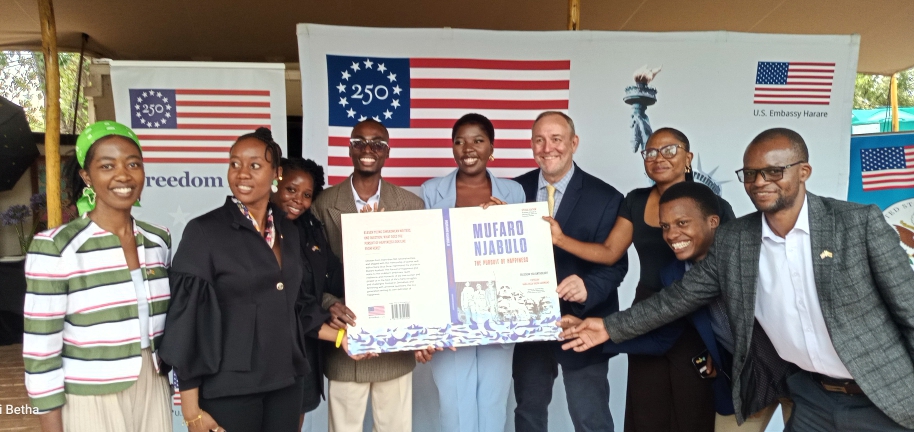
Titled Mufaro Injabulo: The Pursuit of Happiness, the anthology brings together stories selected from 143 submissions received from across Zimbabwe following a nationwide call for young writers to interpret the pursuit of happiness through their own experiences and imaginations.
The publication was officially launched at the Friendship Bench in Harare, bringing together the selected authors, literary professionals, creative industry stakeholders and representatives of the US Embassy.
The initiative forms part of the embassy’s commemorations of 250 years of American independence, drawing inspiration from the United States Declaration of Independence, which identifies life, liberty and the pursuit of happiness as fundamental rights.
Deputy Chief of Mission at the US Embassy, Phillip Nervig, said the publication represented a lasting contribution to cultural exchange between Zimbabwe and the United States, while providing emerging writers with an opportunity to enter the literary industry.
He said the anthology was particularly significant because six of the nine participating writers present at the launch were being published for the first time, giving them an opportunity to establish themselves in Zimbabwe’s literary landscape.
“This book is their introduction to Zimbabwean literature here within Zimbabwe. I was talking with them a few minutes before we started, and one person said that being selected to be included in this anthology was confirmation that she had the talent and skills to continue writing, to really pursue writing, and that it gave her confidence to do so.
“So not only does this book mean a lot to us at the embassy and to perhaps all of you here, but I think it’s especially important to the writers that are featured in it, because it does show that you have the skills, you have the talent, you have the creativity to pursue writing as part of a profession.”
Nervig said the project also demonstrated the potential of partnerships between the public and private sectors in developing Zimbabwe’s creative economy, adding that literature could help build international connections and introduce new audiences to local stories.
He encouraged the writers to establish a supportive network through which they could exchange experiences, mentor emerging authors and strengthen the country’s literary ecosystem.
“This anthology will remain one of the permanent markers of our Freedom 250 celebrations here in Zimbabwe, a lasting testament to the power of storytelling and the friendships we continue to build,” he said.
He also called on the public to support the authors by reading their work and creating opportunities for Zimbabwean literature to reach wider markets.
Business of Books founder Sapi Bachi said the response to the competition demonstrated the depth of emerging literary talent in Zimbabwe, while revealing how younger generations continue to carry memories of the country’s difficult economic period.
She said the organisers had deliberately targeted young and emerging writers to encourage fresh perspectives on happiness and the challenges shaping Zimbabwean society.
“What surprised us the most is, as young as they are, they referenced a lot around what Zimbabwe went through, you know, like the 2008 era, just the challenges that we had in Zimbabwe, which we found quite surprising as to why that narrative in people who are so young.
“So that really surprised us that they had memory of that, but it proved the resilience that we’ve become as Zimbabwean people. And I think that pleasantly surprised us,” Bachi said.
She added that the publication was only the beginning of a longer journey for the writers, who must now develop their readership and find ways of sustaining themselves through their creative work.
According to Bachi, the programme deliberately incorporated entrepreneurial development to help participants understand the commercial side of writing and publishing.
Selina Zigomo, a partner at business support company Interbatchi, which specialises in self-publishing, said the initiative was designed to address gaps in Zimbabwe’s publishing ecosystem by providing emerging writers with professional guidance and opportunities to develop their work.
Zigomo, who has worked in self-publishing since 2017, said the programme focused on helping writers understand publishing standards, market requirements, access to readers and the importance of developing their identities as authors.
“One of the things missing in our publishing ecosystem is a place where young writers can get actual feedback that’s meaningful from seasoned authors and publishing professionals about their books.
“So issues around things like writing to market, issues around things like quality, access to markets, author platforms were things that we were covering in this programme,” she said.
The writers underwent editorial mentorship and creative enterprise development, including online workshops and the British Council’s So Creative self-paced learning programme.
Award-winning American writer and HarperCollins literary scout Nana Ekua Brew-Hammond led the editorial development process, providing individual guidance to the selected authors as they refined their manuscripts.
Zigomo said the mentorship was important in helping writers understand that publishing required more than creativity, with professional editing and market awareness playing an essential role in building successful literary careers.
“All writers work with an editor in a publishing system, and getting that feedback from a seasoned publisher helps a writer to learn what it is to write to be read. And that was really useful for our writers,” she said.
She added that the programme had taken approximately a year to complete, a relatively short period compared with conventional publishing processes, which typically take between 18 and 24 months.
The anthology also seeks to strengthen cultural exchange by connecting American founding ideals with Zimbabwean experiences.
Zigomo said the shared theme provided an opportunity for conversations across cultures, particularly among younger generations.
She noted that the programme had encouraged young writers to present familiar Zimbabwean experiences through different perspectives, contributing to a broader understanding of the country’s evolving identity.
The launch also featured readings from the anthology by Hazel Moyo, Siphathisiwe Lunga and Natasha Muganiwa, offering audiences glimpses into the range of experiences explored in the publication.
The readings touched on childhood memories of economic hardship, family relationships, ageing, illness, love and human dignity.
One contribution opened with the striking reflection, “I was six years old when I learned that hunger has a sound,” using memories of a changing household during the 2008 economic crisis to explore the lasting impact of hardship.
Another story, titled Pugs Which Do Not Need Home, examined the emotional complexities of marriage, ageing and Parkinson’s disease, reflecting on the dignity of allowing a loved one to retain independence even as illness takes its toll.
The anthology’s publication journey was also documented through television profiles produced by 3KTV, broadcast on DStv Channel 293, through the Turnbull book platform.
The publication is expected to become available through Akello Digital Library and Amazon, extending access to the participating writers’ work beyond the launch.
The 11 selected writers named by the organisers are Nisi Tambarirai Mahundi, Hazel Moyo, James Musisiwo Mkiwane, Malachi Gordon Sunguro, Spartisiwe Mitchell Burunga, Fundile Nkala, Tafadzwa Mushayi, Tanyarazwa Amos Jeche, Marshall Zimondi, Natasha Mganiwa and Philip Miza.
Malachi Gordon Sunguro, aged 19 and recently finished with his Advanced Level examinations, was among the young writers recognised through the initiative.
The programme was coordinated by Business of Books, with Kiera Emmons, Public Diplomacy Officer at the US Embassy, serving as master of ceremonies.
The organisers also acknowledged the contribution of the judging panel, 3KTV, Telco Internet and the mentors who supported the writers throughout the development process.
Beyond the publication, the initiative highlights the potential of Zimbabwe’s literary sector to create opportunities for young people through professional development, publishing, entrepreneurship and access to wider markets.
By combining cultural diplomacy with practical support for emerging authors, Mufaro Injabulo: The Pursuit of Happiness offers a platform for Zimbabwean stories to reach new audiences while exploring a universal aspiration through distinctly local experiences.


