

EDDIE ZVINONZWA
Having produced textbooks widely used in Zimbabwean schools alongside prose, poetry, and drama selected as set books, Shimmer Chinodya remains one of the country’s finest writers. In this interview in Harare, the 68-year-old reflects on his journey from a curious schoolboy to an impactful writer and educator, the evolution of Zimbabwe’s literary scene, and the role of books in shaping minds.
Born in Gwelo (now Gweru), the second of seven children, Chinodya belongs to a generation that experienced life in Rhodesia, the liberation struggle, and post-independence Zimbabwe. His fictional works often draw on these experiences, capturing the transition from adolescence to maturity against a backdrop of political and social upheaval.
“Ndiri chikomana (I am a small boy). I am 68 but I don’t feel that age. I feel like 50. Age takes its toll—eyes, ears, legs, teeth—but there is something about growing up. My father died at 70, and I now have two years to reach that. He survived the strife I write about. I am now the father figure in my family, ndini ndinonzi baba, a responsibility I cherish. I am a writer. I started writing very young, in Grade Five,” he says.
Chinodya attended Mambo Primary School in Gweru and Goromonzi High School for secondary education. Before enrolling at the University of Rhodesia, where he earned a BA Honours in English and a Graduate Certificate in Education, he experienced the colonial regime’s restrictions firsthand. Expelled from school for protesting the “Call Up” program, which conscripted young men to fight against freedom fighters, Chinodya later completed his A Levels at St Augustine’s, KwaTsambe.
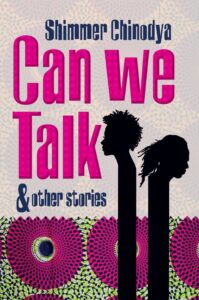
His father inspired his love of reading, which became the foundation for writing. “By Grade Two, I could read the books he brought home. Through reading, I told myself I could write my own stories.” Childhood dreams and experiences informed works like Can We Talk in Hoffmann Street, capturing children’s confusion about adult sayings, and Dew in the Morning, reflecting rural life in Gokwe—fishing in the dam, working fields, and eating chakata (mobola plums).
Chinodya’s political engagement emerges in works like Harvest of Thorns, whose protagonist Benjamin Tichafa navigates post-independence struggles. Even Dew in the Morning contains political undertones, depicting a village head reallocating land—foreshadowing Zimbabwe’s post-independence land tensions. “I started it in Form Three and completed it at university. Ranga Zinyemba gave me his room in Carr Saunders Hostel to finish it,” he recalls.
 Textbook writing came through mentor Barbara (Makhalisa) Nkala, who persuaded Longman that a black Zimbabwean could author a comprehensive English series. “She had faith in me. When people trust you like that, you’re challenged to do your best,” Chinodya says. He also warns that piracy threatens creativity. “We need to educate children and the public that buying photocopied books is wrong. Writers must protect their rights.”
Retiring from the Curriculum Development Unit at 40 and later becoming a professor at St Lawrence University, Chinodya continues to embrace writing as both craft and vocation. “I wake up asking: How much am I writing today? I feel empowered to pursue my hobby as a profession.”
His publications include Dew in the Morning (1982), Farai’s Girls (1984), Child of War (as Ben Chirasha, 1986), Harvest of Thorns (1989), Can We Talk and Other Stories (1998), Strife (2006), Chairman of Fools (2005), Tale of Tamari (2004), Chioniso and Other Stories (2012), and the Step Ahead New Secondary English Course series. Harvest of Thorns Classic: A Play (2016) remains a set book for ZIMSEC Literature in English at Ordinary Level until 2030.
Chinodya’s literary excellence has earned him the Noma Award for Publishing in Africa, the Commonwealth Writer’s Prize for Africa (1990), and the National Arts Merit Award (2007). His contributions to literature and education cement him as one of Zimbabwe’s most influential and enduring creative voices, bridging the nation’s past struggles with the aspirations of its present and future generations.


